
Service · Kitchens & worktops
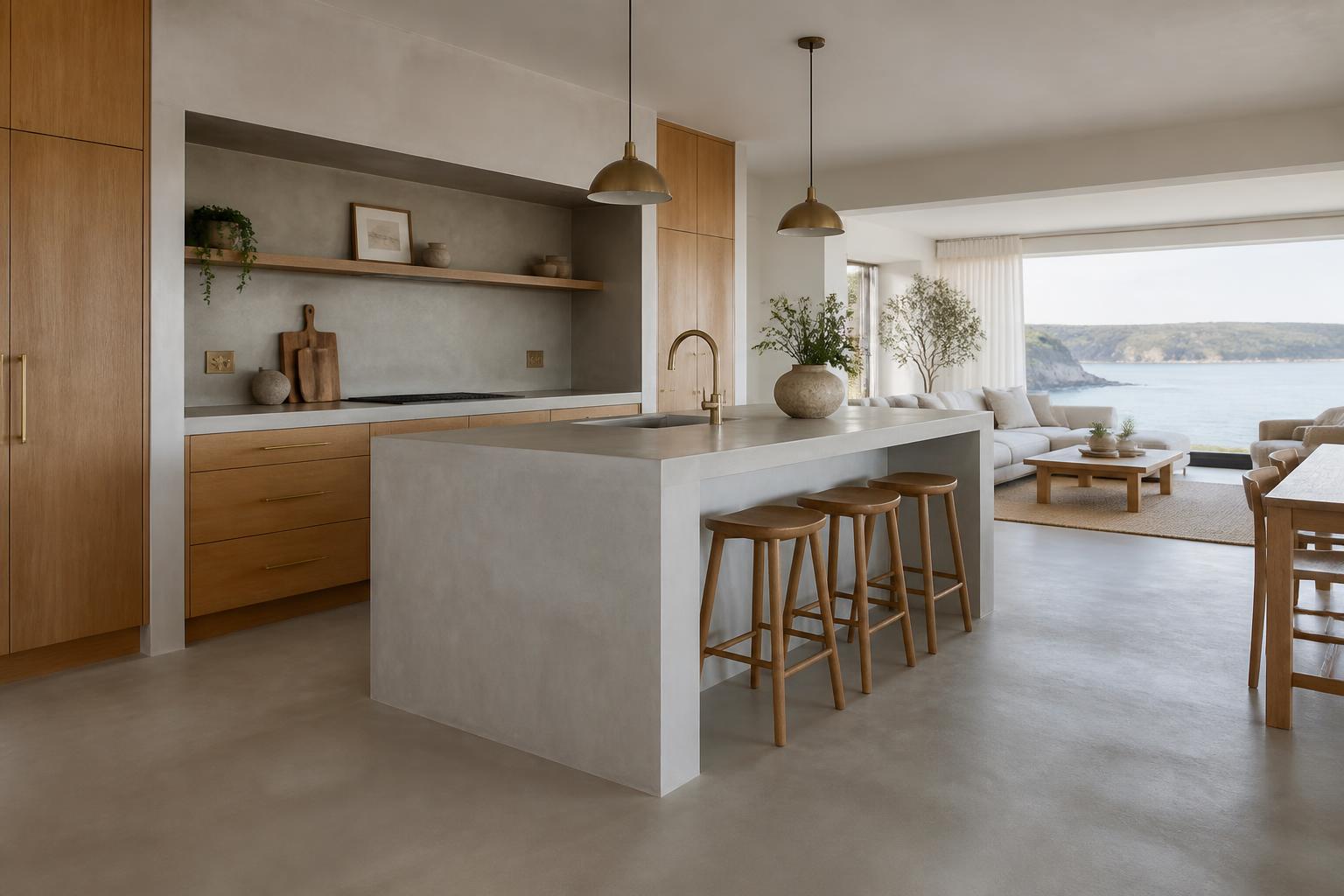
The kitchen as a single sculpted block.
Microcement worktops, islands and splashbacks let the kitchen read as one carved piece of stone rather than a collection of slabs, joints and edges. Heat‑tolerant, food‑safe and quietly architectural.
Microcement kitchen worktops and islands are hand‑trowelled 2–3mm mineral surfaces, sealed with a four‑coat 2K polyurethane to be heat‑resistant, food‑safe and seamless from worktop to splashback. Hand‑applied across Cornwall by Cornwall Microcement.
Stone worktops are limited by the slab they come from. Microcement isn't. The result is a kitchen island that flows uninterrupted from horizontal counter to vertical waterfall, with no visible seam at the corner. For long galley runs it solves the problem of mid‑joint mismatch in natural stone.
The right specification for a working kitchen
A microcement kitchen surface is a different specification to a microcement wall or floor. We use a denser CimentArt grade, a food‑safe sealer system, and extra finishing passes to compact the surface. The result is harder than a painted MDF worktop, repairable in a way that quartz isn't, and far quieter visually than veined stone.
How it ages
Like a good butcher's block or a brass tap, a microcement worktop earns character. It develops a patina around the sink and prep zone. Most clients love this; for those who don't, the surface can be re‑sealed every few years to reset the finish.
Best for
- Bespoke kitchen islands with monolithic returns
- L‑shaped or curved worktops that natural stone can't span
- Splashbacks behind hobs and sinks
- Pantry shelves, breakfast counters and dining benches
- Holiday‑let kitchens that demand visual impact
What you get
Features that set this installation apart.
- Continuous worktop, island side and splashback
- No joints — even on runs longer than any stone slab
- Heat‑tolerant under trivets and pans (always use a board for direct heat)
- Food‑safe once sealed with food‑grade two‑component sealer
- Repairable in situ if knife‑damaged
- Pairs beautifully with oak, walnut, brass and stainless
- Apply over MDF, ply, existing laminate or stone
- Available in deep ink, warm taupe, bone, ivory and more
Questions
Frequently asked.
Is it really tough enough for a kitchen?+
Yes — when correctly specified for kitchen use, with the food‑grade two‑component sealer and additional compaction passes. We always recommend a board under direct heat, and a chopping board for direct knife work — the same as you would on any worktop.
Can it go over my existing laminate worktop?+
Often yes, provided the laminate is well‑bonded and the substrate beneath is structurally sound. This is a great way to transform a tired kitchen without ripping out cabinets.
What colours work in a kitchen?+
Warm taupes and bones in lighter kitchens; deep inks and earthy charcoals in dramatic ones. We always produce a sample panel in the actual kitchen before committing.
How do I look after it?+
Wipe with warm water and a soft cloth, or pH‑neutral cleaner. Avoid bleach and aggressive solvents. Re‑seal every 3‑5 years for a working kitchen — we offer this as an aftercare service.